Low-value items
The office chair, the cutting machine, the uniforms, the workshop tools. Things used for years on end, but too cheap to deserve a fixed-asset card. They sit in the warehouse like any other goods, and when you give one to an employee you put it into operation with a document — from then on you know who holds it and how its cost is written off.
Where to find it: Sidebar → Nomenclature → the Low-value items tab
The tab has two sub-tabs: Handovers into operation, where the documents live, and Usage purposes, where the rules for writing the cost off live.
Start with the usage purposes
You cannot hand anything over until you have at least one usage purpose. It answers the question "what happens to the item's value once I have put it into use" — and the answer is a rule, not a decision of the moment.
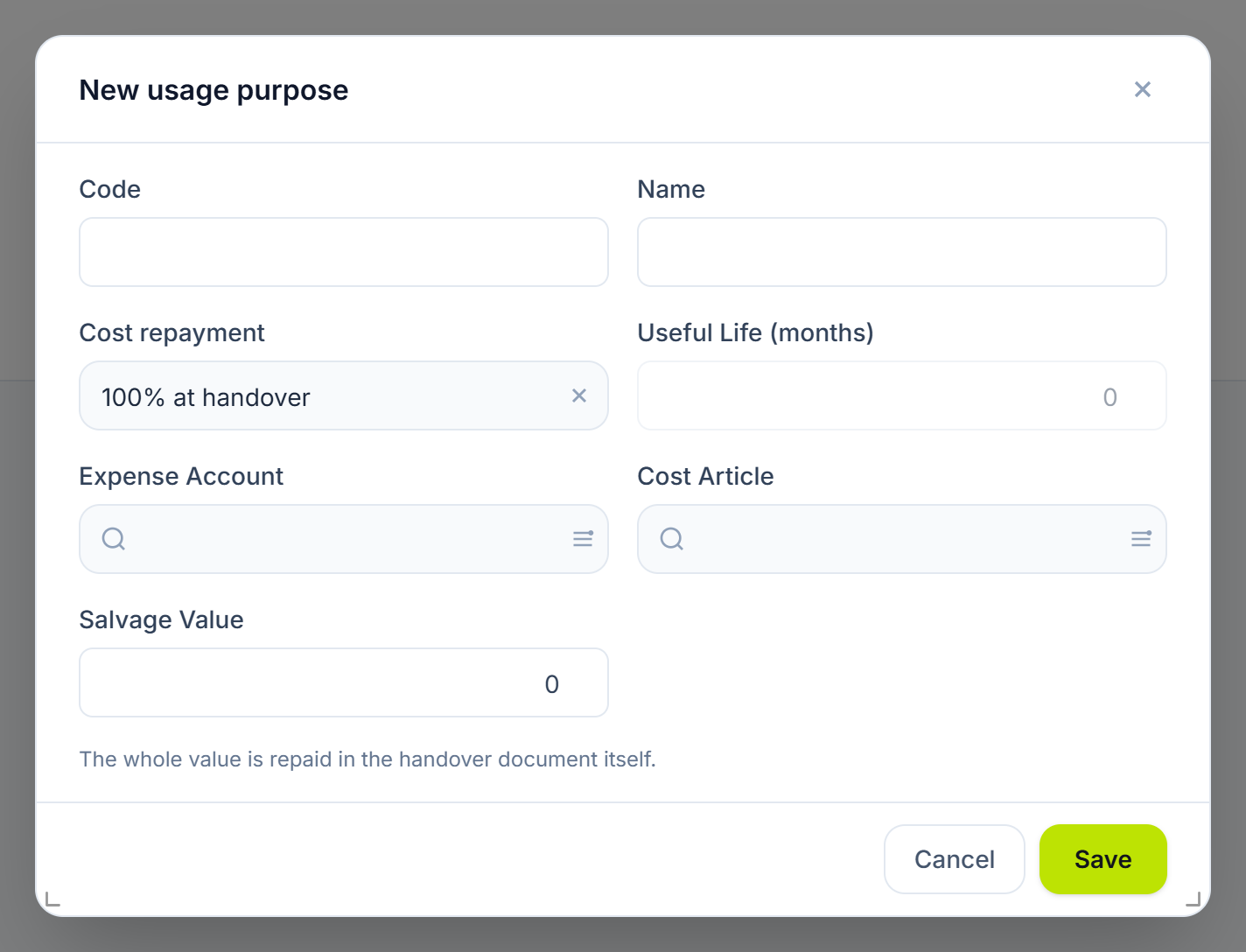
Cost repayment is the field that matters. It has three options:
| The option | What happens to the value |
|---|---|
| 100% at handover | It is written off entirely in the handover document itself. This is the usual practice in Moldova, which is why it comes selected by default |
| Linear | It is written off monthly, over the Useful Life (months), at each month-end close |
| Proportional to output | It is written off according to how much has been produced |
Useful Life is asked for only on the linear option — on the others it stays at zero. The expense account and the cost article say where the written-off value lands. The salvage value is what is left of the item at the end of its life; usually zero.
The text below the fields changes with the method chosen and tells you, in words, what you picked.
You configure it once and reuse it on every handover. If it sat on the document line, the same chairs could get different methods from one handover to the next, and the monthly wear would no longer have a stable rule to follow.
The handover into operation
Where to find it: Sidebar → Nomenclature → Low-value items → the Handovers into operation tab, the New button
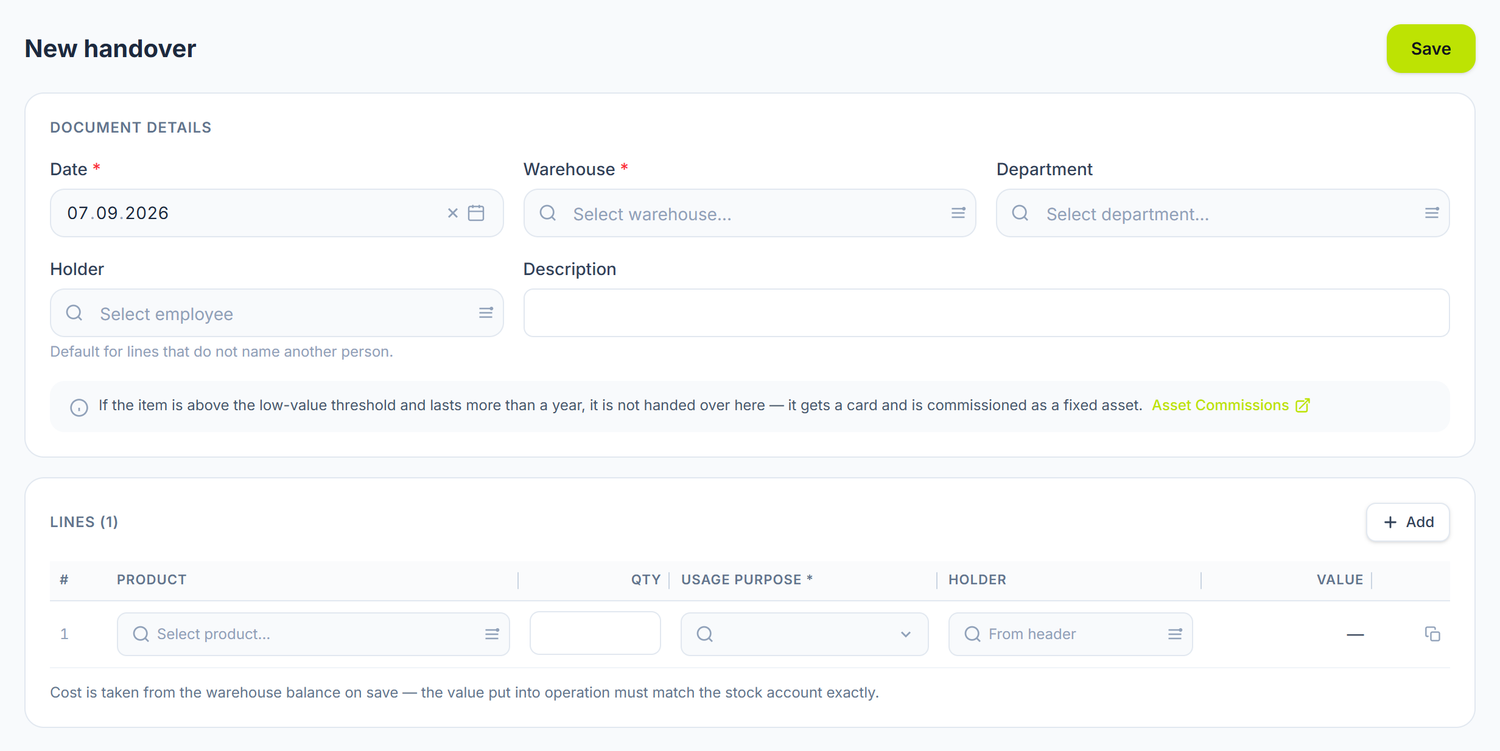
In the header you fill in the Date and the Warehouse — the two fields with a red asterisk. The Holder in the header is the default value for the lines that don't name another person, so put the one who takes most of the items and correct only the exceptions, directly on the line.
On each line you pick the product, the quantity and the Usage purpose — required, because it decides what happens to the value. The Holder column reads "From header" as long as you don't touch it.
The price is not filled in. The cost is taken at save from the warehouse balance, and the Value column fills itself. It is written below the table as well: the value put into operation must be exactly the one at which the item sits in stock, otherwise the stock account is left with a remainder that matches no real item.
The box in the header reminds you: an item that exceeds the low-value threshold and is used for more than a year is not handed over from here. That one gets a fixed-asset card and goes through commissioning. The link in the box takes you straight there.
What happens on posting
The item moves out of the stock account into the account for items in operation, in the holder's name. On 100% at handover purposes, the value is written off at the same time, to the expense account from the purpose.
On linear purposes nothing is written off in the document: the value is worn down month by month, and the step runs at the month-end close. Items already written off at handover no longer appear in that step.
Frequently asked questions
Where do I see who holds an item?
On the handover document, in the line's Holder column. The in-operation account keeps records per employee, so its balance tells you what each person has in their custody.
I gave the item to another employee. What do I do?
You make a new handover to the new holder. The old document stays as the history of the first handover.
Can I change the repayment method after I have handed items over?
Changing the purpose changes the rule for future handovers. The batches already put into operation keep the rule they left with — otherwise the wear of past months would no longer match what was recorded.
Why doesn't the product appear in the list?
It must have a balance in the chosen warehouse. With no stock there is no cost to pick up, so there is nothing to hand over.
Related pages
- Products and catalogue — where the items enter the records from
- Warehouses — the location the handover is made from
- Fixed assets — for what exceeds the low-value threshold
- Month-end close — the step that wears the value down on the linear method