Accounting policy
Here sit the decisions the company takes once and then applies to every document: how stock is valued, what happens to non-deductible VAT, from which month depreciation starts, when the fiscal year begins. The platform reads them at every posting, so what is written here ends up in the entries.
Where to find it: Sidebar → Settings → the Accounting policy tab
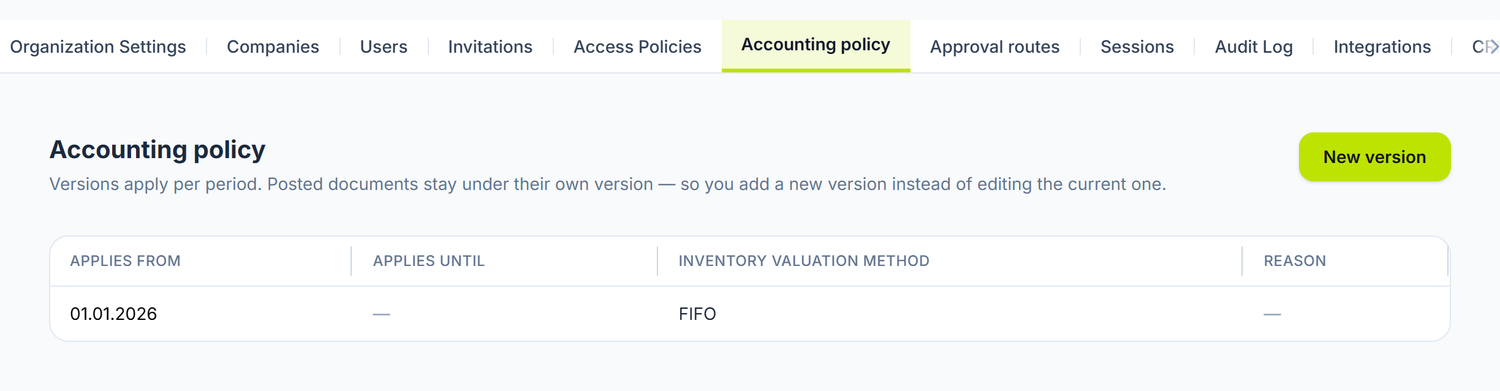
It isn't edited, a version is added
That is the screen's first rule and it is written right under the title. You won't find an Edit button on the table row — you find New version.
The reason is practical: an accounting correction is made by unposting a document and posting it again. If the policy could be rewritten, a document from eight months ago, reposted today, would silently get different accounts than the ones it left with — although nobody touched the document. With dated versions, each document stays under the rule that was in force on its date.
The table shows exactly that: Applies from, Applies until — empty on the current version — and the Reason for the change.
The text you write there ends up in the printed accounting-policy order. Write it as if an inspector would read it two years from now: "switch from weighted average cost to FIFO for imported goods", not "changed".
What is decided in a version
| The decision | What it applies to |
|---|---|
| Inventory valuation method | The default value for new catalogue items |
| VAT on purchases | Whether the VAT on supplier invoices is deducted or included in the cost |
| Expense account and cost article for non-deductible VAT | Where the VAT that isn't deducted lands |
| Typed price | Whether the price on the line includes VAT or not |
| Retail goods valuation | Acquisition cost or sale price, for shops |
| Fixed-asset depreciation starts and Intangible-asset amortization starts | From the month of commissioning or from the next month, each on its own row |
| Fiscal year starts in | January, at ordinary companies |
The account + article pair for non-deductible VAT is checked when the policy is saved, not later: either you fill in both, or neither. Otherwise the first document that would need them would fail at posting, and the cause would be in a settings screen nobody looks at any more.
It has its own screen, with its own periods, because it changes independently of the accounting policy and the platform reads it at the document's date. A second copy of it in the settings would diverge from the first.
When you add a new version
- When you change a method — you move stock from weighted average cost to FIFO, for example. The new version applies from the beginning of the period you decided the change in.
- When you register or deregister as a VAT payer — if that changes your deduction rule.
- At the start of the year, if the shareholders' meeting approved changes.
The old version doesn't disappear: it gets an end date and stays in the table, as history.
Frequently asked questions
I got a value wrong in today's version. What do I do?
You add a new version, with the same start date. The wrong one is closed, and the documents posted in the meantime you repost so they pick up the correct rule.
Does the policy change documents already posted?
No. They keep the entries made under the version of their date. They change only if you unpost them and post them again.
Why does the valuation method also appear on the product card?
The policy gives the default value for new items. On a particular item you can change it — a company can keep most goods on FIFO and a few on weighted average cost.
Related pages
- Accounting periods — closing the month and locking it
- Products and nomenclature — where the valuation method is seen per item
- Depreciation — the rule for when depreciation starts